
programming note: marquand summer

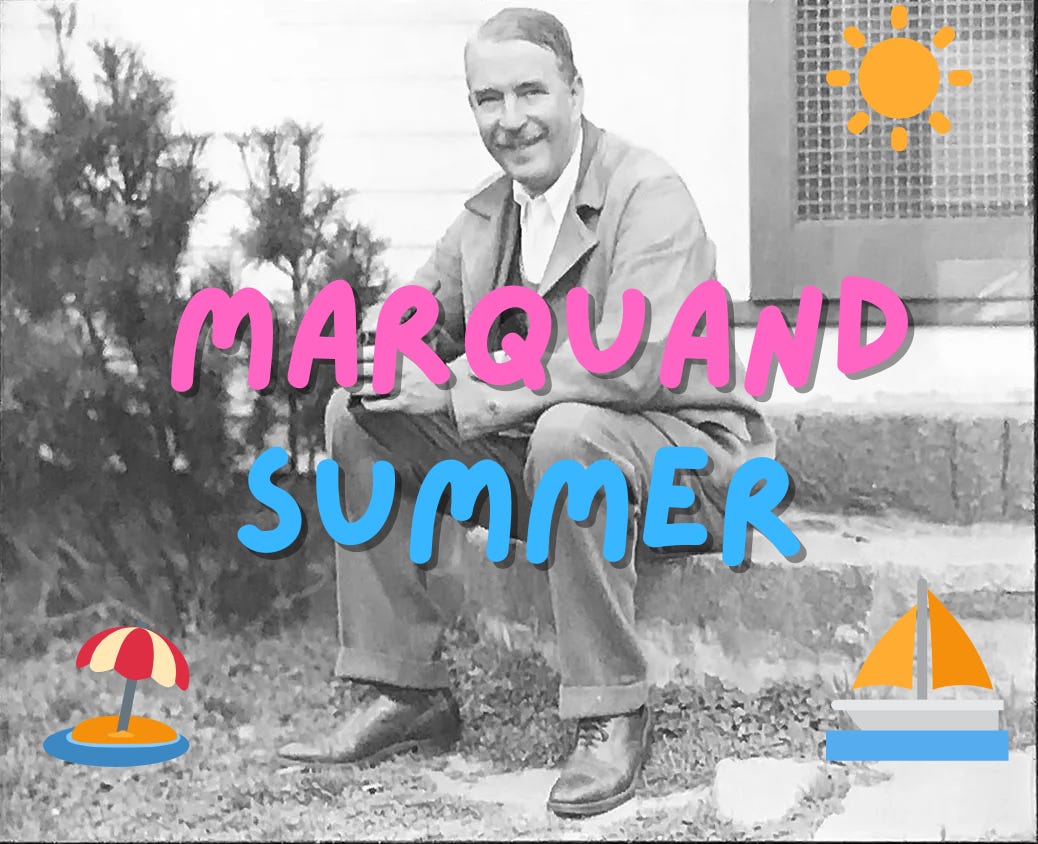
This post is the formal declaration of Marquand Summer.
What is Marquand Summer? Marquand Summer is when you read the novels of John P. Marquand. Call it a “pop-up,” although I won’t.
Who is John P. Marquand? John Phillips Marquand (1893-1960) was the author of 22 novels and four short story collections, winner of a 1938 Pulitzer for The Late George Apley. Raised in Newburyport, Massachusetts, Marquand graduated from Harvard and worked as a magazine writer after serving in World War I. As a novelist, Marquand maintained parallel careers. He published thirteen literary novels — comedies-of-manners dissecting New England’s class structure — which met critical acclaim and commercial success. He also published nine popular crime novels, six featuring a Japanese spy character named Mr. Moto. His sales figures are skewed somewhat by reissues and World War II-era Armed Services Editions, but by any account he was one of the bestselling authors of the twentieth century; Life cited him as “the most successful novelist in the U.S.” in 1943.
Wow. Why haven’t I heard of this guy? Right? I can’t think of another writer who reached such commercial heights simultaneous with institutional adulation. Granted, it wasn’t all roses: in a 1987 Commentary retrospective (citing an earlier Randall Jarrell essay I can’t find), Terry Teachout dismisses Marquand’s early novels as trashy, his later work as melodramatic. Edmund Wilson ripped Marquand to shreds in The New Yorker. In an appreciative Washington Post column from 2003, Jonathan Yardley revisits H.M. Pulham, Esquire, a mid-career Marquand novel first serialized by McCall’s in 1940:
Like all the rest of Marquand’s work, it is written with what the author himself called the “smooth technique” routinely disparaged by his critics. Its prose flows without apparent effort, which scored Marquand no points at a moment in literary history that favored Hemingway’s self-conscious leanness, Fitzgerald’s poetic romanticism and Faulkner’s dense complexity. Never mind that it takes a great deal of work and discipline to perfect a “smooth technique,” and never mind that Marquand’s prose is just about as distinctive and readily identifiable as that of other writers celebrated as stylists; in the places where literary reputations are made, he was dismissed as a slick entertainer.
Marquand was a volume shooter, and his books share a number of themes and settings; the fictional town of Clyde is a stand-in for his native Newburyport. The novels are long, plotty, and chatty, centering on affluent WASPs and their unfulfilling marriages. Marquand himself was a bitter, unhappy man who took offense and got divorced a lot. I’m grasping at straws — nearly all his books are out-of-print. I figured the rights were tied up in estate, or something, but this low-rent ebook affair has them now. No one seems interested in keeping these books in circulation.
You’re telling me there’s no money to be made off the best-selling novels of the twentieth century? While like, Speedboat is in its fifty-seventh reprint? I don’t make the news, I just report it!
Hm. Well, how’d you get into Marquand? I’d heard his name batted about over the years — as a young man I was really into Edwin O’Connor, another forgotten Pulitzer winner from Massachusetts, and they overlapped. The 1940s through 1960s is my favorite era of American novel; sometimes I’ll go hunting through lists of Pulitzer and National Book Award nominees from those decades. Most of the honorees are household names, or at least writers I’ve read. But some are lost to time, and they intrigue me the most. How could these major writers be forgotten in a matter of decades? Is it the authors’ fault, or the industry’s? Usually the latter, in my experience: great books disappear from shelves, and the world moves on.
For the last few years I’ve been tearing through the work of Hortense Calisher, a midlist novelist who published dozens of books to mixed reception; she received a few National Book Award nominations but didn’t get much recognition otherwise. The books are hard to find now but they are fucking bangers — vibrant, evocative works with a strange, lyrical quality, running the gamut from historical fiction to sci-fi. It’s all out there if you go looking for it.
In 2022 I decided to track down a Marquand book, and borrowed 1949’s Point of No Return (the only one NYPL had in print). Point of No Return is, I believe, one of the four or five best American novels. It’s a masterfully paced, pitch-perfect domestic narrative with vivid scenery — country clubs, banks, leafy subdivisions, musty traincars. The setup is a misdirection: there’s this Truman Show-style social experiment going on, an anthropologist pulling levers and fiddling with the townsfolk’s class mobility.
American Pastoral is a good point of comparison, the way it frames an idyllic twentieth-century Americana and then slowly unravels it. The narrator in No Return thinks he’s worked his entire life to transcend circumstances of his birth, but turns out it was all bullshit. Or was it? He’s got a wife and kids and a fancy job. Pretensions are as real as anything else; Lord knows you can’t take anything with you. I was excited to read more Marquand, but never got around to it. Ergo, Marquand Summer.
Cool. Who else would you compare Marquand to? The aforementioned Teachout essay likens him favorably to James Gould Cozzens and W. Somerset Maugham; John O’Hara and Peter De Vries also come up. I’ve read a decent amount of O’Hara, and I don’t see much resemblance beyond the time period and broad class themes — Marquand had a light touch, and was more adept writing 600-page novels.
O’Connor and J.F. Powers are decent analogues, if not thematically. Their books sing, and they’re distinctly Roman Catholic in flavor. But they’re wide-lens social novels, taxonomizing big casts of characters while delving into individual protagonists. They’re about people living through history, and how that history shapes lives and communities. In Point of No Return, Clyde is home to a gradient of snooty upper-crusters, but there’s a seedy waterfront populated by questionable operators — a land of contrasts. MFAs weren’t a thing back then, but these books are not what would today be described as “MFA novels.”
Dominick Dunne is another possible reference point, given his page-turners about elite New England families. I enjoy Dunne quite a bit; he and Marquand shared the gift of observation. But Dunne’s books are admittedly pulpy, I think Marquand was a superior literary writer.
There’s only time on this earth for so many books. Do we need to read some forgotten American novelist who’s been dead as long as he was alive? Have you considered foreign literature, or nonfiction, or poetry, or philosophy texts? You raise some compelling points, but this is a workingman’s newsletter — we’re doing our best. For those with the time and resources, immersion in an author’s complete work is a singular experience. You watch them grow as thinkers and writers, their craft, ideas, and ambition evolving in parallel with their careers and the world.
There are a few cherished authors (Barbash, Exley, Goodwillie, Hoby, Kauffman, O’Connor, Passaro, Rathgeber, Riley, Specktor, Stagg, Wenzel) with tight or in-progress catalogs, and I’ve read all their work. Others (Abdurraqib, Berlin, Brodkey, Carver, Cheever, Cole, Dee, Gaitskill, Gates, Hornby, Irving, Kennedy, McInerney, Russo, Senna, Stegner, Swados, Tartt, Wallace, Warren, Wolfe) have larger catalogs, and I’m missing one or two. This experience, more than any individual book, defines a reading life — some people even go to grad school for it.
In my early twenties I read all of Edwin O’Connor’s stuff and wrote an essay for the dreaded Los Angeles Review of Books — a stilted, labored piece, very 2016-core. But because there’s so little contemporary writing on O’Connor, it gets cited all the time. The University of Chicago Press slapped a pull-quote on their reissue of The Last Hurrah; strangers still email me about it regularly. The canon is ours for the taking!
Alright. How exactly does one acquire a Marquand novel? You’ve alighted upon another Marquand Mystery. Dude sold millions and millions of books, and I’ve never seen one in a used bookshop. Where did they go? You can download the ebooks with a library card; eBay and AbeBooks have some cool mass-market paperbacks for a few bucks.
Thanks. Anything else to know about this guy? Marquand was as blue-blood as they come, a descendant of the earliest Massachusetts settlers, but his father lost his shirt in the Panic of 1907 and sent young JPM to live with relatives. The younger Marquand developed a real inferiority complex over it — even at Harvard he was convinced of his ostracism — which would inform his work.
In the 1930s Marquand bought a huge plot of land on Kent’s Island in Newburyport; it fell into disrepair after he died, sold to the state of Massachusetts, and the buildings were razed. His oldest son, John P. Marquand Jr. (1923-1995), published a novel in 1953 under the pen name John Phillips.
There are three Marquand biographies in various stages of circulation: Stephen Birmingham’s The Late John Marquand, from 1972; Millicent Bell’s Marquand: An American Life, from 1979; and Philip Hamburger’s J.P. Marquand, Esquire: A Portrait in the Form of a Novel, first serialized in The New Yorker in 1952. (The latter title is an allusion to H.M. Pulham, Esquire — Marquand did not, to my knowledge, have a legal background.)
Some of the finest Marquand criticism online can be found on the Neglected Books Page, courtesy of the estimable Brad Bigelow. The statistician Andrew Gelman moonlights as a recreational Marquand scholar, and has written about him on his blog. Marquand’s letters are archived at Harvard; the Marquand Society has a skimpy (and seemingly abandoned) dot-org webpage.
What are you hoping to get out of this? What do we get out of anything? The last two summers I fell into historic reading slumps, so hopefully this keeps me moving. I love reading outdoors and will need to secure print copies (Kindles on the beach are an abomination). Realistically I’ll read four or five of these books before Labor Day — I reserve the right to read and blog about other stuff — but summer is a state of mind. I’m convinced Marquand is a forgotten titan of American fiction, but if not, surely there’s something to be learned about literature, publishing, and the world.
How can I get involved? You already are, but reach out if you’re interested in cracking a book. I’d love to do a few Pen Pals-style discussion posts about Marquand — if you’d be down to trade a few emails, I’d be happy to send you a lightly-used paperback to read, and a few dollars for your time. Hit me up here, or in the other usual places.
Put me down for So Little Time, which I've been meaning to re-read for years.
I read Apley last year and it quickly became a favorite. I wrote about it a few times on here. It really is a great prequel to The Last Hurrah. I don’t know how someone not from Boston would take to it, it really struck something deep with me.